The True Cost of a Slow Website in 2026 (And How to Fix It)
A slow website actively drains revenue, increases acquisition costs, and kills SEO. Discover the real business impact of poor Core Web Vitals in 2026.
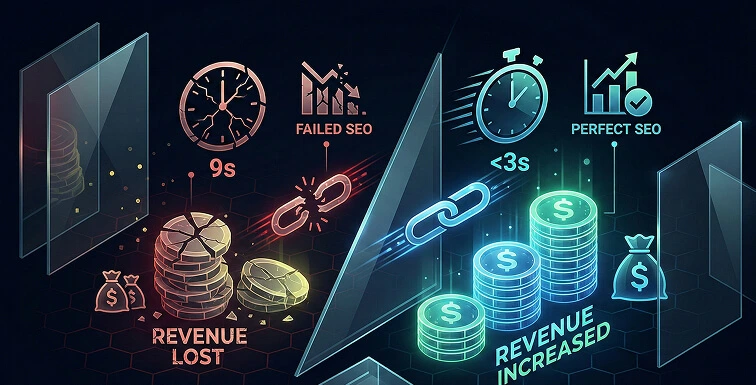
A slow website is no longer just a technical inconvenience, it’s a measurable revenue leak. In 2026, website performance directly determines search visibility, advertising efficiency, customer trust, and conversion rates simultaneously.
Millisecond delays actively inflate customer acquisition costs, increase bounce rates, and reduce lifetime customer value. If your digital infrastructure lags behind user expectations, you are not simply losing visitors, you are funding your competitors.
This guide explains the real financial cost of poor website performance, how Core Web Vitals influence rankings, and how to execute professional website performance optimization to protect your revenue.
The Real Business Cost of a Slow Website
The cost of poor website performance appears across three critical business areas: revenue, marketing efficiency, and search visibility.
1. Revenue Loss and Conversion Drop
Modern users expect near-instant page loading. When a website hesitates, trust declines immediately, and abandonment rates increase dramatically.
Research consistently shows that:
- A 1-second delay can reduce conversions by up to 7%
- Bounce rates increase exponentially after 3 seconds
- Conversion rates drop sharply beyond 4 seconds
For an ecommerce business generating $10,000 per day, a one-second delay can translate to over $250,000 in lost annual revenue.
High-performance infrastructure is directly tied to profitability, particularly for Shopify ecommerce stores and lead-generation websites.
2. Increased Customer Acquisition Costs (CAC)
Slow websites waste advertising budgets.
When users click paid ads but abandon the page before it loads:
- Cost-per-click (CPC) delivers zero ROI
- Quality scores decline
- Retargeting costs increase
- Conversion funnels break
Performance optimization acts as a multiplier for marketing efficiency. Faster websites reduce acquisition costs while increasing conversion rates simultaneously.
3. SEO Rankings and Organic Traffic Loss
Google has made website performance a confirmed ranking factor through its Core Web Vitals framework.
If your site performs poorly:
- Search rankings decline
- Crawl frequency decreases
- Indexation slows
- Competitors outrank you
In competitive industries, speed often determines who captures market share.
Core Web Vitals: The Metrics That Control Rankings
Google evaluates user experience using three primary metrics known as Core Web Vitals.
Largest Contentful Paint (LCP)
Measures how long it takes for the main visual content to load.
Target: Under 2.5 seconds
High-performing sites: 1.0 – 1.8 seconds
Interaction to Next Paint (INP)
Measures responsiveness when users interact with your page.
Target: Under 200 milliseconds
This metric replaced First Input Delay (FID) and is now a major ranking signal.
Cumulative Layout Shift (CLS)
Measures visual stability and unexpected movement on the page.
Target: Less than 0.1
Poor layout stability damages trust and usability.
Why Website Speed Matters More in 2026
User expectations have evolved dramatically due to:
- 5G and fiber internet adoption
- Instant-loading mobile apps
- AI-powered search experiences
- Faster competitor websites
Consumers now interpret slow websites as:
- Untrustworthy
- Outdated
- Low quality
- Risky to purchase from
Speed has become a brand perception factor, not just a technical metric.
Common Causes of Slow Website Performance
Most performance issues come from four technical bottlenecks:
1. Unoptimized Images and Media
Large images dramatically increase load time. Modern formats like WebP and AVIF reduce file size significantly without losing quality.
2. Bloated Code and Scripts
Excess JavaScript, unused CSS, and heavy frameworks create unnecessary rendering delays.
3. Poor Hosting Infrastructure
Cheap shared hosting environments often cause:
- High server response time
- Traffic bottlenecks
- Performance instability
Professional hosting and global CDNs improve speed dramatically.
4. Plugin and App Overload
Excess plugins in WordPress or apps in Shopify increase database queries and script execution time.
Replacing bloated plugins with optimized code often produces major performance gains.
How to Improve Website Speed (Professional Approach)
Improving performance requires a systematic optimization process.
At Cortiva Digital, performance audits typically include:
- Image compression and next-gen formats
- Code minification and script deferral
- Server optimization and caching layers
- CDN implementation
- Database optimization
- Plugin and app reduction
- Core Web Vitals tuning
You can learn more about our performance optimization services.
The Competitive Advantage of a Fast Website
Companies investing in performance consistently achieve:
- Higher conversion rates
- Lower acquisition costs
- Better SEO rankings
- Increased customer trust
- Improved engagement metrics
Speed is no longer optional; it’s a growth strategy.
Frequently Asked Questions
Does website speed affect SEO?
Yes. Website speed is a confirmed ranking factor. Google uses Core Web Vitals to measure user experience, and slow websites often rank lower than faster competitors.
How fast should a website load in 2026?
To maximize SEO performance, Largest Contentful Paint (LCP) should be under 2.5 seconds. High-performing websites typically load within 1.0 to 1.5 seconds.
Can slow websites hurt conversions?
Absolutely. Even small delays create friction that reduces trust and increases abandonment rates, directly impacting revenue.
What is a good Core Web Vitals score?
A passing score requires:
- LCP under 2.5 seconds
- INP under 200 milliseconds
- CLS below 0.1
Final Thoughts
In 2026, performance is not a luxury, it’s the foundation of digital revenue.
Businesses that actively optimize website speed consistently outperform competitors who treat performance as an afterthought. Hidden technical bottlenecks silently drain revenue, inflate marketing costs, and limit growth potential.
If your website growth has plateaued, performance issues may be the root cause.
👉 Contact us today for a free technical performance audit and discover exactly where your bottlenecks are.
Ready to upgrade your architecture?
Stop letting outdated monolithic platforms bottleneck your revenue. Let's build a high-velocity digital flagship.
Discuss Your ProjectFurther Reading
How to Replace Shopify Apps with Custom Webhooks & n8n
Boost Shopify store speed and save hundreds monthly. Learn to replace slow, costly app bloat with custom webhooks and self-hosted n8n automation.
Next.js Hidden Costs: The Shift to Island Architecture
Next.js is costing e-commerce brands money in hidden hydration taxes and server compute. Discover why Island Architecture is the definitive fix in 2026.
Your Website Is Not a Brochure. It's a Broken Employee.
A static website is a liability. Learn how scaling businesses use custom web apps and n8n automation to capture leads, sync CRMs, and close clients 24/7.