How to Replace Shopify Apps with Custom Webhooks & n8n
Boost Shopify store speed and save hundreds monthly. Learn to replace slow, costly app bloat with custom webhooks and self-hosted n8n automation.
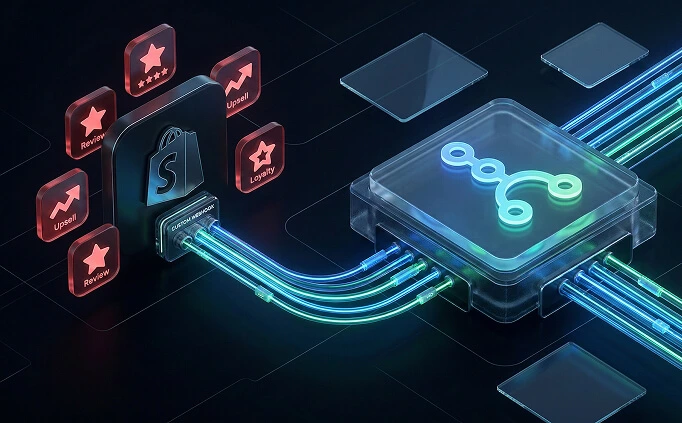
How to Replace Shopify Apps with Custom Webhooks & n8n
You built a lean, fast Shopify store. Then you installed an app for reviews, and another one for upsells. One for bundles, one for loyalty points, one for abandoned cart emails, one for inventory alerts. Eighteen months later, your store is running 24 apps, your PageSpeed Insights score has collapsed from 78 to 41, and you’re paying $600 a month in subscription fees for functionality that mostly overlaps.
This is not a niche problem. It’s the default trajectory for any Shopify store that scales, to reach for the app store every time a new operational need surfaces. And it’s quietly killing your conversion rate, your SEO rankings, and your margin.
What App Bloat Actually Does to Your Shopify Store
The term “app bloat” gets thrown around loosely. Here’s what it means technically.
Every Shopify app you install has the ability to inject JavaScript and CSS into your storefront’s <head> or before the closing </body> tag. Each script must be downloaded, parsed, and executed by the browser before your page is fully interactive. On a mobile device average connection, that execution time is not measured in frames, it’s measured in seconds.
The compounding problem is conflicts. App A loads jQuery 3.4. App B loads jQuery 3.6. They disagree. Your product page’s image gallery breaks on iOS. You open a support ticket with both vendors. Both tell you it’s the other app’s fault. Meanwhile, your store is broken for every iPhone user visiting on a Tuesday afternoon.
The Real Cost Breakdown Most Owners Miss
Subscription fees are the visible cost. The invisible cost is larger:
- A one-second delay in mobile load time reduces conversion rates by up to 20%, according to Google’s own commerce benchmarks.
- Every app adds an external DNS lookup, adding 20 - 120ms of latency per resource.
- Conflicting scripts create intermittent JavaScript errors that are nearly impossible to reproduce in a dev environment, but fire constantly in production.
- App vendors update their code on their own schedule and a background update to an app you haven’t thought about in six months can silently degrade your store overnight.
When you add those costs together against the $300 - $700/month in subscriptions a mature Shopify store typically carries, the business case for a different approach becomes difficult to argue against.
The Professional Alternative: Custom Code, Webhooks, and Self-Hosted Automation
The core insight is this: most Shopify apps are solving generic problems for thousands of merchants simultaneously. Their code is built to be flexible, configurable, and safe across wildly different store configurations. That generality is precisely what makes them heavy.
Your store has one configuration. You need one solution, built specifically for how your operations actually run.
Shopify Webhooks: The Foundation of Custom E-Commerce Workflows
Shopify exposes a comprehensive webhook system that fires real-time events for practically every meaningful action in your store: order created, inventory updated, customer tagged, fulfillment completed.
Instead of installing an app that polls your store every few minutes and executes logic through a third-party server in an unknown region, you can build a direct pipeline: Shopify fires the event, your endpoint receives it, your logic executes, your systems update.
No polling delay, No third-party data custody, No per-task pricing that scales against your order volume.
Self-Hosted Automation with n8n and Custom Scripts
For operations teams who need visual workflow management without writing raw Node.js or Python, n8n is the tool the Shopify development community has largely converged on. It’s open-source, self-hostable on a $5 - $10/month VPS, and provides a node-based workflow builder that can receive Shopify webhooks, transform the data, and push it to any downstream system; your 3PL, your ERP, your warehouse management platform, your internal Slack channel, without routing through a SaaS intermediary.
The workflow you would have paid $49/month for as a dedicated app becomes a self-contained automation that you own outright, runs on infrastructure you control, and costs you nothing beyond the server it runs on.
Real-World Example: Replacing a $30/Month Inventory Sync App
Here’s a concrete scenario. You sell across Shopify and a wholesale portal. You’re currently running an inventory sync app that charges $30/month and syncs stock levels every 15 minutes. When you get a spike in wholesale orders, your Shopify store oversells because the sync window hasn’t closed yet. You’ve issued three partial refund apologies in the last quarter because of it.
The custom solution is a Shopify inventory_levels/update webhook that fires the moment stock changes, paired with a lightweight endpoint that pushes the updated quantity to your wholesale portal’s API in real time.
The sync is no longer every 15 minutes. It is instantaneous.
The operational difference is significant. But so is the financial one. A custom webhook endpoint, once built, costs nothing to run per-transaction. The $30/month app was charging you a subscription whether you processed 100 orders or 10,000. Custom infrastructure scales with your hosting cost, not your revenue.
What This Looks Like Applied Across Your Operations
The inventory sync is one example. The same architectural pattern; Shopify webhook triggers custom logic, custom logic updates downstream systems, which in return applies across your entire operations stack:
- Order routing: Tagging and routing based on product type, customer segment, or shipping postcode, without a rules-based app injecting scripts into your storefront.
- Loyalty mechanics: Built directly against Shopify’s Customer API, with points stored in your own database rather than a third-party platform that holds your customer data hostage behind a monthly fee.
- Post-purchase review requests: Triggered by fulfillment webhooks and sent via your own email infrastructure, removing the need for a dedicated review app with its own tracking pixels and storefront JavaScript.
- Fraud scoring integrations: Calling a risk API at order creation to auto-tag or auto-hold orders without installing a full fraud prevention app that adds 200ms to every checkout page load.
Each of these is a workflow your store already needs. The question is whether you want to pay for them monthly in perpetuity, or build them once and own them.
Custom Development Is an Investment, Not an Expense
There is a version of this conversation where custom development sounds expensive relative to a $30/month app. That framing only holds if you look at month one.
A single custom automation workflow, properly built and documented, has a payback period measured in months, not years. When you factor in subscription consolidation, conversion rate recovery from a faster storefront, and the elimination of the ongoing engineering cost of debugging app conflicts, the economics shift decisively.
More importantly, you stop being operationally dependent on a vendor’s pricing decisions. The app you built your reorder workflow around just raised its price 40%. You’ve seen this happen, You’ll see it again.
If your Shopify store is running more than eight apps and your PageSpeed score is below 60, the architecture needs a technical review before it needs more apps.
We conduct focused technical audits that map exactly which apps can be replaced with custom automation, what the build cost looks like, and what the projected monthly savings are. The audit takes one week and produces a specific roadmap, not a generic recommendation.
Ready to upgrade your architecture?
Stop letting outdated monolithic platforms bottleneck your revenue. Let's build a high-velocity digital flagship.
Discuss Your ProjectFurther Reading
Next.js Hidden Costs: The Shift to Island Architecture
Next.js is costing e-commerce brands money in hidden hydration taxes and server compute. Discover why Island Architecture is the definitive fix in 2026.
Your Website Is Not a Brochure. It's a Broken Employee.
A static website is a liability. Learn how scaling businesses use custom web apps and n8n automation to capture leads, sync CRMs, and close clients 24/7.
The True Cost of a Slow Website in 2026 (And How to Fix It)
A slow website actively drains revenue, increases acquisition costs, and kills SEO. Discover the real business impact of poor Core Web Vitals in 2026.