Your Website Is Not a Brochure. It's a Broken Employee.
A static website is a liability. Learn how scaling businesses use custom web apps and n8n automation to capture leads, sync CRMs, and close clients 24/7.

Your Website Is Not a Brochure. It’s a Broken Employee.
Every hour your website sits idle pulling no data, triggering no workflows and converting no visitors, it is costing you money you can calculate precisely. Not in abstract “lost opportunity” terms, but in actual payroll math: if a human sales development rep costs £50,000 per year, and your website performs the job of zero SDRs, the gap between what your site does and what it could do is a quantifiable line item on your P&L.
The businesses that understood this three years ago are now operating with significantly lower customer acquisition costs than competitors running structurally identical products on bloated WordPress themes. The gap is not marketing spend. It is architecture.
The Old Way: What a “Brochure Website” Actually Costs You
A brochure website is defined by what it cannot do without human intervention.
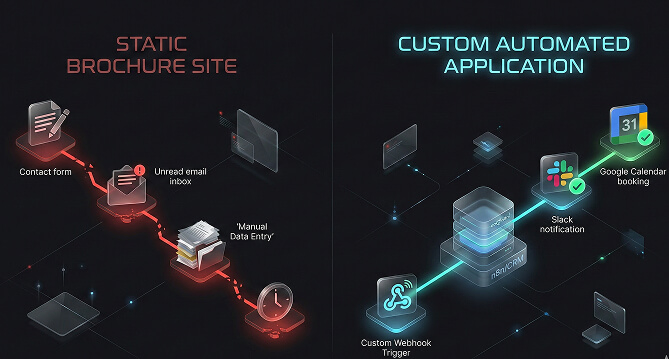
A prospect lands on your services page at 11:40 PM. They read your case studies. They want to start a project. The site offers a contact form that fires an email to your general inbox. That email sits unread until 9:15 AM. By then, the prospect has had a discovery call with a competitor whose site booked the meeting automatically, sent a pre-qualification questionnaire, added them to a CRM pipeline, and triggered a personalised follow-up sequence, all before your team reached for their first coffee.
This is not hypothetical, it’s the default operational gap for any business running a static website.
The technical liabilities compound the operational ones:
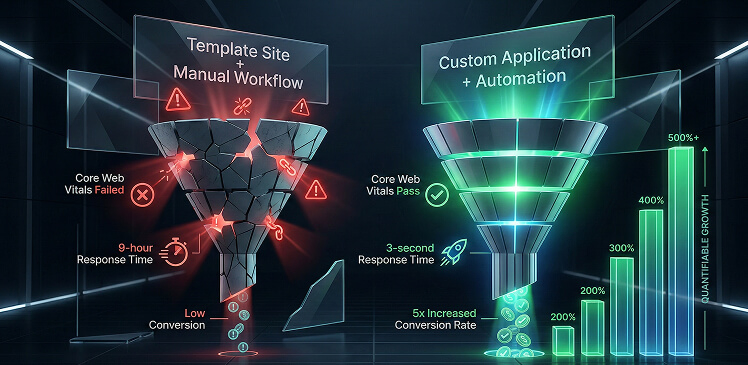
- Page speed degradation from plugin stacking: A standard WordPress or Wix setup accumulates plugins over time - SEO tools, chat widgets, form handlers, analytics scripts, cookie banners, etc. Each one of them injects JavaScript that must be parsed and executed by the browser. A site that scored 78 on PageSpeed Insights at launch commonly drops below 50 within 18 months. At that point, Google’s Core Web Vitals are failing, organic rankings are suppressed, and every pound spent on paid acquisition is working against a leaking funnel.
- No integration layer: Data entered into a contact form lives in a form inbox. It does not flow to your CRM, your project management tool, or your invoicing system without a human manually entering it twice. That manual entry is error-prone, slow, and a waste of skilled time.
- Zero conditional logic: Your site treats a £15,000 enterprise enquiry and a spam submission identically. Both get the same autoresponder. Neither gets triaged, scored, or routed.
The New Way: Custom JavaScript Architecture with an Automation Backend
A custom-engineered web application is not a better-designed brochure, It’s a different category of tool.
The Frontend: Performance-First JavaScript Architecture
Modern frontends built on frameworks like Astro or Next.js, with selective hydration islands for interactive components, ship zero unnecessary JavaScript to the browser by default. Static pages like service descriptions, case studies, pricing overviews are pre-rendered at build time and served from a CDN edge node with sub-50ms response times globally.
The implications for Core Web Vitals are structural, not cosmetic. Largest Contentful Paint (LCP) drops because there is no server compute in the critical path. Interaction to Next Paint (INP) drops because the browser’s main thread is not occupied bootstrapping a framework to render text that was always going to be static. You are not optimising a slow site, You are building one that cannot become slow through the mechanisms that make template-based sites slow.
The Automation Layer: n8n as Your Operations Backend
The frontend is the face. The automation layer is where the ROI compounds.
n8n is an open-source workflow automation platform that you self-host or deploy on managed infrastructure. Unlike Zapier or Make, it imposes no per-task pricing that scales against your operation’s volume. A workflow that runs ten times a day costs the same to operate as one that runs ten thousand times.
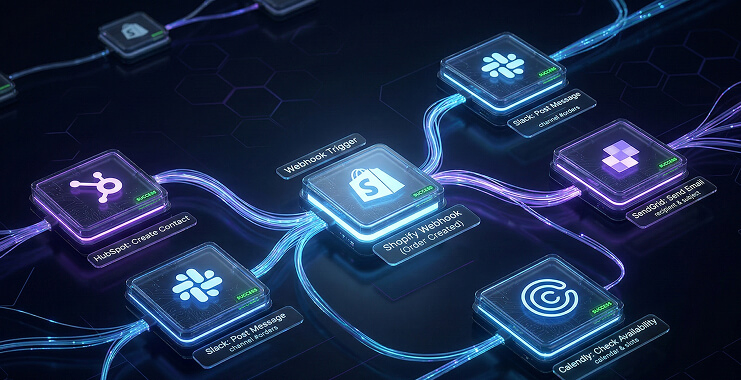
When a lead submits your contact form, a webhook fires instantly to your n8n instance. From that single trigger, a workflow can simultaneously:
- Create a qualified contact record in your CRM (HubSpot, Pipedrive, Attio).
- Score the lead based on form fields and route it to the correct pipeline stage.
- Post a structured summary to the relevant Slack channel with the lead’s company, budget range, and project type.
- Send a personalised confirmation email from your domain with relevant case studies matched to the prospect’s stated industry.
- If the lead scores above a defined threshold, trigger a calendar booking link in the confirmation email.
Total latency from form submission to CRM entry: under three seconds. Total human involvement required: zero, until a qualified meeting is on the calendar.
The ROI Is Not Theoretical
The time savings from eliminating manual data entry and lead routing are measurable in hours per week, and these hours compound into headcount decisions as the business scales.
The conversion impact of speed is documented at the infrastructure level. A site moving from a 52 to a 91 PageSpeed score on mobile recovers organic positions that had been suppressed by Core Web Vitals failures. For a business spending £5,000/month on Google Ads to compensate for weak organic performance, recovering three first-page positions can directly reduce that dependency.
The response time advantage is perhaps the most underappreciated factor. MIT research on lead response times established that contacting a prospect within five minutes of enquiry increases conversion likelihood by 900% compared to a 30-minute response window. An automated system that responds in three seconds does not just beat your current process, it operates in a different performance category entirely.
The compound effect: better Core Web Vitals → higher organic ranking → lower paid CAC → faster lead response → higher close rate. Each component reinforces the others. None of them require ongoing manual effort once the architecture is built.
When This Is Required (And When It Doesn’t)
A custom-engineered web application with an automation backend is not appropriate for every business at every stage. A pre-revenue startup validating a market hypothesis should not be spending on this. A £2M ARR service business with a 15% manual overhead in its lead handling, a PageSpeed score below 60, and a website that predates its current service offering should be.
What it requires is a precise technical audit before a line of code is written. The audit maps your current lead flow, identifies every manual touchpoint, scores the technical performance of your existing site, and produces a prioritised remediation roadmap with projected ROI attached to each component.
What it does not require is rebuilding everything simultaneously. The most effective implementations start with the highest-leverage intervention, usually the lead capture and routing automation, and build from there.
Cortiva Digital conducts focused technical audits for scaling service businesses and funded startups. The engagement is scoped, time-bound, and produces a specific deliverable: a technical specification of your current architecture’s gaps, a prioritised build roadmap, and projected performance and revenue impact for each component.
Ready to upgrade your architecture?
Stop letting outdated monolithic platforms bottleneck your revenue. Let's build a high-velocity digital flagship.
Discuss Your ProjectFurther Reading
How to Replace Shopify Apps with Custom Webhooks & n8n
Boost Shopify store speed and save hundreds monthly. Learn to replace slow, costly app bloat with custom webhooks and self-hosted n8n automation.
Next.js Hidden Costs: The Shift to Island Architecture
Next.js is costing e-commerce brands money in hidden hydration taxes and server compute. Discover why Island Architecture is the definitive fix in 2026.
The True Cost of a Slow Website in 2026 (And How to Fix It)
A slow website actively drains revenue, increases acquisition costs, and kills SEO. Discover the real business impact of poor Core Web Vitals in 2026.